
Project 03
Atmospheric Transport of Antibiotic Resistance
Antibiotic resistance genes travel through urban air on particles. We measure how they are distributed across particle sizes, what they travel with, and what that means for exposure.
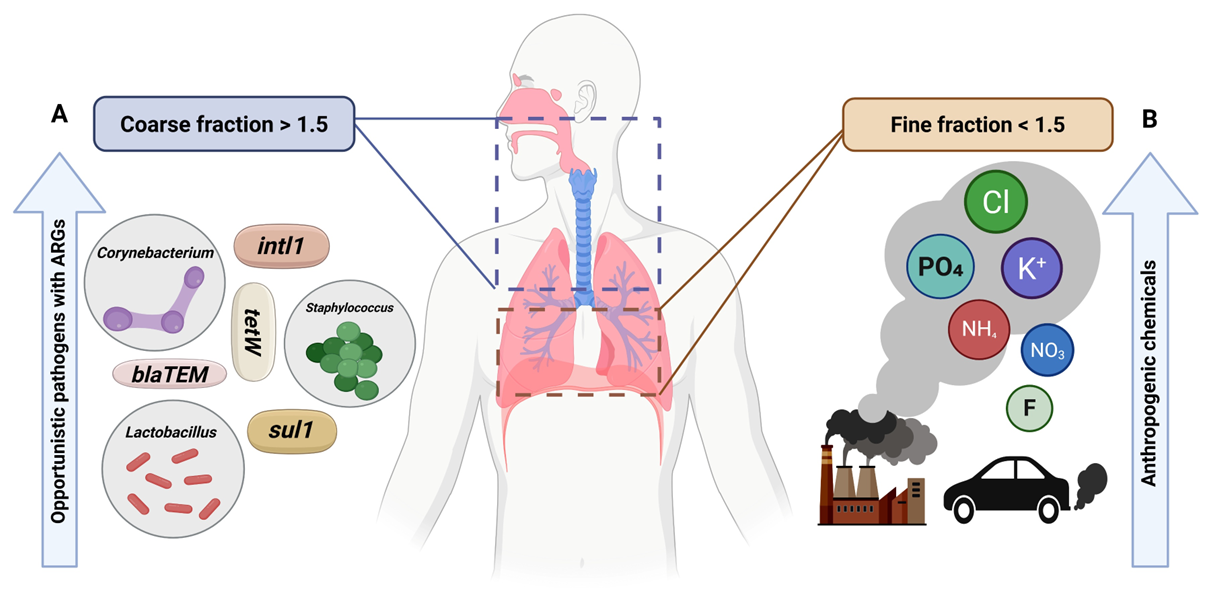
Graphical abstract, Habeebrahuman et al., J. Hazard. Mater., 2026
01Research overview
Airborne aerosols affect urban air quality and public health through the transport and inhalation of chemical pollutants and microbial agents, including antibiotic-resistant bacteria.
The relationships between particle size, environmental parameters, chemical and microbial composition, and the dispersion of antibiotic resistance remain poorly understood. This project addresses that gap directly.
02Scientific background
Antibiotic resistance is usually studied in clinical and water environments. The atmosphere is a far less examined route, even though particles can carry both resistant organisms and free resistance genes, and even though inhalation is a direct exposure pathway.
Particle size governs how far a particle travels and how deeply it penetrates the respiratory tract. Resolving the microbial and chemical load by size is therefore central to understanding exposure.
03Research questions
- How are antibiotic resistance genes distributed across airborne particle sizes?
- What chemical components do resistance-carrying particles travel with, and what does that indicate about their source?
- Does seasonality or particle size matter more in shaping airborne chemical and microbial composition?
- What do these distributions imply for inhalation exposure in urban environments?
04Experimental approaches
Size-segregated aerosol sampling
Collection of airborne particles separated into size fractions in a mid-sized urban area, across seasons.
Chemical characterisation
Analysis of ionic and carbonaceous components to distinguish natural, mineral-derived and anthropogenic contributions.
Microbial community sequencing
Characterisation of the bacterial community within each particle size fraction.
Antibiotic resistance gene quantification
Targeted quantification of resistance genes, including tetW, sul1, blaTEM and the integron marker intI1.
05Findings and significance
Fine and coarse particles differed systematically. Coarse particles mainly contained mineral-derived components and carbonate carbon from natural sources, with greater microbial diversity dominated by Firmicutes and Actinobacteriota. Key opportunistic pathogens — Acinetobacter, Staphylococcus, Lactobacillus — and antibiotic resistance genes, with tetW and sul1 the most abundant, followed by blaTEM and intI1, were significantly more abundant in the coarse fractions.
Habeebrahuman et al., Journal of Hazardous Materials, 2026 · read the paperParticle size, rather than seasonality, primarily determined chemical composition and microbial community structure. Genera including Acinetobacter, Delftia, Paucibacter and Pseudomonas correlated positively with anthropogenic chemicals but negatively with resistance genes, while resistance-gene-harbouring genera were strongly associated with mineral nutrients.
Habeebrahuman et al., Journal of Hazardous Materials, 2026 · read the paperThese findings suggest that coarse urban aerosols function as reservoirs of antibiotic resistance genes and opportunistic pathogens, with abundance peaking in warmer months — raising public health concerns through inhalation exposure.
06Related publications
07Collaborations and funding
Other research directions

The Dustosphere
Dust events carry bacteria, fungi and viruses across continents. We study the microorganisms that survive the journey and what their survival strategies mean for the carbon cycle and for biotechnology.

Marine Bioaerosols & Aerial Connectivity
Microorganisms cross continuously between water and air. We follow them out of the ocean and inland waters, through the atmosphere, and back down again — and ask what that exchange does to the ecosystems at both ends.